Showing posts with label peatland. Show all posts

Wednesday, 15 March 2017

Peatland ACTION re-launch


The Cabinet Secretary for Environment, Climate Change & Land Reform, Roseanna Cunningham MSP, has re-launched the Peatland ACTION project.

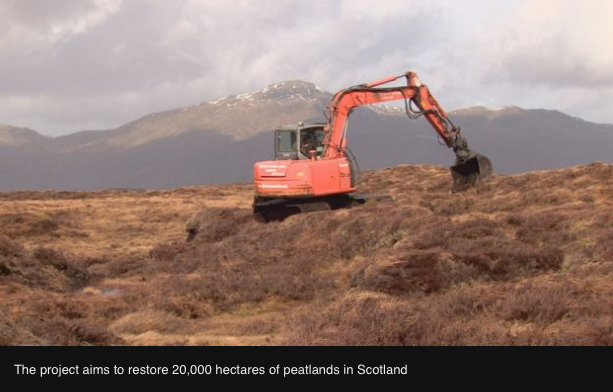
The Peatland ACTION fund received a further £8 million from the Scottish Government, in January. The investment allows the Peatland Action Fund, which is administered by Scottish Natural Heritage (SNH), to continue working with its partners and restore a further 8,000 hectares of this precious peatland habitat in Scotland, during 2017/18.

The fund is open for applications on 1st April but the project team would like to hear about proposed projects now. Updated application requirements and guidance are available from the Project webpage.

In this phase of the project, there is an emphasis on extending the geographical reach to the Western Isles, and for further contractor training. More information will be become available in due course through updates on the project's webpages and posts on social media accounts: @SNH_Tweets and @ScottishNaturalHeritage

The Scottish Government has issued a press release.

BBC News article includes a video clip with the voice-over provided by Andrew McBride, the Peatland ACTION Project Manager.

Monday, 20 February 2017

This Valentine’s Day, love your bog…

Photo: Scottish Land & Estates
See the blog post by Anne Gray of Scottish Land & Estates.  She provides some useful background to  why the appropriate management of peatland has become more important, recently.


Monday, 23 January 2017

Draft Climate Change Plan & Peatland


The Scottish Government has published its Draft Climate Change Plan and this sets out the Government's ambitions for peatland restoration.  Long term funding is to be provided to deliver large-scale peatland restoration.  The members of the Forum may have a role to assist with the Awareness Raising policy, outlined below.

Peatland Restoration Progress
Since 2013, through the Peatland Action Initiative, around 10,000 hectares of peatlands have been restored through Scottish Government led action, working with public and private land managers across Scotland.

Ambitions for peatland
By 2020, 50,000 hectares of degraded peatland will have been restored, from a 1990 baseline, and by 2030 we will have increased this to 250,000 hectares – an improvement of valuable soils in around 20% of Scotland’s landmass. By 2050, Scotland’s expanded peatlands will be thriving habitats, sustaining a diverse ecosystem and sequestering more carbon than ever before.

Extract from the Draft Climate Change Plan - Section 13.4, p131
Our ambition – Peat 
13.4.3  By 2030, 40% of degraded peatland will be restored to good condition. This policy action will have considerable impact by converting peatlands from emitting carbon to acting as a carbon sink as well as reducing emissions from degraded bogs. The restored peatland will also help mitigate flood risk and improve water quality, as well as helping to increase biodiversity in restored areas.

13.4.4  As well as providing increased carbon storage, this large-scale peatland restoration delivery across Scotland will also produce multiple benefits for communities and the economy. The key sectors expected to see benefits are tourism, food and drink and the environment.

13.4.5  To make progress towards this ambition, we will focus on achieving a significant increase in the scale of degraded peatland restored, from a 1990 baseline to:
• 50,000 hectares restored by 2020
• 250,000 hectares restored by 2030

13.4.6  Our longer term ambition is that by 2050, Scotland’s expanded peatlands will be thriving habitats, sustaining a diverse ecosystem and sequestering more carbon than ever before.
Peat policy outcomes, policies, development milestones and proposals

Policy outcome 1: To enhance the contribution of peatland to carbon storage, we will support an increase in the annual rate of peatland restoration, from 10,000 hectares in 2017/18 to 20,000 hectares per year thereafter.

Policies which contribute to the delivery of policy outcome 1 
1)  Restoration grants: We will provide grant funding to support eligible land managers to deliver peatland restoration. Levels of funding will enable at least 20,000 hectares of peatland restoration per year from 2018/19.
2)  Awareness raising: Working through partnership, we will put in place tools and information to develop the capacity, skills and knowledge of land managers, contractors and others, to deliver peatland restoration.

Saturday, 25 June 2016

Peatland Code at the Royal Highland Show


I was pleased to be able to support the presentation about the Peatland Code that took place on the Scottish Land & Estates stand on Thursday, 23rd June.  The benefits that flow from better management of peatland are becoming clearer and it is encouraging that ambassadors amongst the land management community are coming forward to state their support.  However, it is difficult to justify the cost of restoration work without external funding and this is how the Peatland Code aims to help; one of the roles for the Code is to provide a match-making service between those who want to restore peatland and those who might want to fund this, perhaps as part of a Corporate Social Responsibility package.

If you want to know the IUCN UK Peatland programme is running a webinar on 26 July. The Peatland Code Webinar: A practical solution to a global problemThe Peatland Code Webinar: A practical solution to a global problem.


With thanks to SL&E for hosting the Peatland Code event, their hospitality provided a good opportunity to meet a range of Moorland Forum members and others with an interest in Scotland's moorlands and uplands.

Saturday, 7 November 2015

Peatland Action - Team Meeting - day 2

After some late night informal discussion, day 2 of the Team Meeting, on Friday 6 November, took place indoors.

I provide some support for the project by coordinating and advising on the demonstration events that the project officers are running; these promote the work of the project, and allow discussion of peatland restoration and management.  

Demonstration Events
While some larger demonstration events will continue to be held, where it is appropriate, some project officers have found it effective to take one or two people with them when inspecting work in progress.  This involves little extra effort and is a good way to engage with people who want to know more about peatland management.  Project Officers have been encouraged to use this approach.

A more strategic event is being planned the end of February, and this will be held near Lanark.  The target audience will be senior staff from Forestry Commission Scotland, and from other organisations within reach of Lanark.  

Some discussion took place about having a team meeting at the end of this phase of the project, in March 2016, and this will probably be held near Edinburgh.  This might provide an opportunity to host an evening reception to present the achievements of Peatland Action to a wider audience.

Peatland: Management vs Restoration
I was encouraged by the increasing reference to peatland management, as I believe this represents the peatland story moving into a more mature phase.  It is easy to get carried away by all the excitement associated with hordes of large machinery moving across moorland, and it can be forgotten that this is a long-term game.  

Restoration work is required in areas where the peat is eroding fast, and the worst cases are where the vegetation has been removed to leave bare peat.  In other areas, where the vegetation cover remains, a more subtle approach is required to manage the vegetation more sympathetically and perhaps shift the balance between dry heath species and mosses to make it more resilient in the future.

We need to integrate peatland management into best practice management of our upland and moorland areas.  To do this the Peatland Action project must be able to engage with farmers as well as estates.  Recognition of the changing importance of peatlands will inevitability take a long time and the 'peatland community' must be patient; we are making progress but there is still a long way to go.

Barriers to Adoption
The project is aware that there are some barriers, perceived and real, that are preventing some people for embracing the message about peatland.  An example is the concern of livestock farmers that re-wetting will increase the incidence of fluke and increase the amount of Bog asphodel, which is associated with photo-sensitisation in sheep.  It may be possible to address some of these concerns by producing some guidance, but other issues may require further research.  I will be establishing from project officers where such barriers are thought to exist, and I would welcome input from others.


Friday, 6 November 2015

Peatland Action - Team Meeting - day 1

Part of Inshriach Restoration Site, near Aviemore
I had an interesting day with the Peatland Action team in Aviemore, yesterday, that included a visit to nearby peatland restoration sites.

Seeing this work first hand confirms my conviction that the restoration of peatland is long overdue.  In the past our treatment of these areas as waste land has been to ignore their value in so many ways.  Their impact on water quality is the most obvious; when you can see how much peat material gets washed away when the protective layer of vegetation is removed you can begin to understand why our rivers turn brown after heavy rain.  We should also not forget the eroding effect of wind on peat that has dried out.

One of the areas we visited yesterday had lost about a metre of depth, since concern was first expressed about the condition of the area in 1986.  While there maybe between three and five metres of peat on this site still, it will not last long at this rate of erosion.

Some of the Peatland Action Project Officers
The first task for restoration work must be to restrict erosion by restoring the vegetation cover.  If the water table is then raised, this surface layer will become self-sustaining.  The ideal is then for  sphagnum mosses to colonise the area which will then start to form more peat.

This is all long-term stuff.  The Peatland Action team have been tasked with spending £3m in the 9 months that ends on 31 March 2016.  When compared with the scale of the problem caused by our lack of sensitive management in the past, this is a drop in the bucket, but it is a good start.  More funding and more awareness of the challenge we face is required.

Thursday, 24 September 2015

Peatland Restoration - event near Crianlarich - 28 Sep 15

There are a few places left at this event which is being run by SRUC at their hill farm, near Crianlarich on Monday next week (28 Sep 15).

Details of how to apply for a place are contained in the flyer below.


Tuesday, 4 August 2015

Peatland Action - Project Officers' Meeting


Last week, I attended a meeting of the Peatland Action Project Officers in Thornhill, Dumfriesshire, and this included a visit to peatland sites hosted by Buccleuch Estates. It made a pleasant change to operating close to home, and to be able to show people from other parts of the country how remote parts of the Southern Uplands can be.

The aim of the meeting was to share knowledge and ideas between the Project Officers who based all over Scotland – from the Shetlands to Galloway.

The project has received additional funding of £3m for this financial year, to build on the budget of £5m that closed at the end of March 2015. The new funding will be allocated to additional peatland restoration work and the window for submitting applications closes on 17 August. There is still time to submit an application, if you are quick!

I am helping to set up demonstration events to communicate the benefits of peatland restoration to a wider audience, and one of the most important audiences will be other land managers. These events will cover restoration techniques, but I think one of the most important messages is that by improving the condition of peatland there are benefits for everyone. It is not just about large intervention projects to restore degraded peatland or re-vegetate areas of bare peat; the benefits can come simply from better management of the land. 

Bare peat areas should be given priority for restoration; as these areas are unstable, the impact of wind and/or water causes them to erode quickly. As a result, bare peat loses the most carbon, both to the atmosphere and to watercourses, in the form of peat particles and dissolved carbon. Stabilising the peat and raising water tables encourages the growth of sphagnum mosses that cover the bare peat, thereby reducing the erosion and loss of the carbon from the moorland.

For more detail, the project has its own section on the SNH website.

Tuesday, 21 July 2015

Burning in the Uplands - new RSPB-led Study published

A new study led by the RSPB Centre for Conservation Science has revealed the extent of moorland burning across Britain’s upland areas. This is the first time upland burning has been mapped in detail across mainland Britain.

Using aerial photography and satellite images, 45,000 1-km squares were mapped across Scotland, England and Wales, and revealed that burning occurred across 8,551 of these squares, including 5,245 squares in Scotland.  In the ten year period covered by the study from 2001 to 2011, the number of burns recorded increased rapidly by 11 per cent each year.

For more information see the RSPB press release.  The paper has been published in Biological Conservation.  The abstract of the paper can be viewed online and the full paper is available to download for a fee.

This paper, and others like it, will need to be considered as part of the review of the Muirburn Code.  Our understanding of the uplands has improved in many areas since the current Code was published in 2001, but the expansion of our understanding of peatland has been the biggest area of change.

Saturday, 11 July 2015

Peatland Action - Reborn


The Scottish Government has allocated Peatland ACTION a further £3 m to spend on peatland restoration this year. See Scottish Government news release 9 June 2015 'Climate change action heats up'.

Scottish Natural Heritage (SNH) was allocated £5 million to spend on:
  • restoring and managing peatlands to maintain carbon stores and encourage carbon sequestration restore peatland ecosystem functions; 
  • enhancing ecosystem resilience to climate change; and 
  • building peatland restoration capacity and understanding amongst land managers, contractors, advisors and the public. 
The Peatland ACTION project was established to respond to this challenge in the last financial year, and work was funded across 107 sites throughout Scotland.  Building on this success, the allocation of a further £3m, to spend before the end of March 2016, will allow the Peatland ACTION project to extend the amount of restoration work that can be carried out.

Applications for Funding
Details about how to apply for funding for peatland restoration work are available from the Peatland ACTION part of the SNH website.  The closing date for applications is 17 August - if this is of interest you need to act now.

Demonstration Events
I am working with the Project to the Peatland Project Officers who are in post around the country to set up Demonstration Events.  The programme of events is starting this month and will run into the autumn.  Anyone interested in attending an event can contact me so that I can put them in touch with the appropriate Project Officer.


Thursday, 5 February 2015

International Year of Soils - Thematic Groups


Five Soil Thematic Groups – Soil Water, Soil and Climate, Soil and Biodiversity, Soil and Land Use, Soil and Society - have been created to provide information on potential International Year of Soils activities and identify what is achievable during the IYS which ends on World Soils Day, 5th December 2015. 

The Administrator represented The Director at the first meeting of the Soil and Land Use Group on 28th January.  Forum member organisations represented included: SEPA, NFUS, JHI, Scottish Government, The Heather Trust and SRUC.

The Groups have been tasked to:
  • Raise awareness of the benefits that soils can bring to society, organisations and individuals;
  • Support and provide integration between organisations in achieving higher impact from their activities; and
  • Examine how resources (human and / or financial) can be pulled together.
The Royal Highland Show was identified as a key opportunity for collaboration and will be discussed further at the next meeting. An education focus group has been proposed to create resources and learning sessions for educational professionals.  Anyone interested in participating in this should contact Kirsten Leask.

The aim through the year is to achieve greater recognition of soils and their benefits and the group will be examining how to carry forward and maximise the use of combined staff and material resources.

Colleen McCulloch is the point of contact for more information.  Contact details are available from the Administrator – use the Moorland Forum contact form.

Monday, 15 December 2014

Peatland action - Demonstration Sites

I met Andrew McBride (Peatland Action Project Manager) in Battleby, today to discuss further development of proposals to establish a suite of demonstration sites across Scotland as part of the Peatland Action (PA) project.

These sites will be on land where work funded by the PA project has been carried out, and the aim will be to establish sites that represent different types of peatland in different conditions.

The initial idea we discussed was to use the sites for events to allow people to visit and find out at first hand what peatland management involved. They would also learn about the impact of the work on other enterprises.  However, the sites could be used in many different ways and I will be exploring other possible uses, as well as the demonstration concept, in the further proposals I produce on behalf of the Forum in January.

I would welcome input from any Forum member who has a view about this work.

Tuesday, 28 October 2014

A briefing from the Peatland Conference 2014

A grip block in operation 
This briefing will be presented at the Moorland Forum meeting on 31 October 2014

The conference was held in Inverness, 20-22 October 2014, and was the sixth in an annual series of conferences organised by the IUCN UK Peatland Programme the main funder of this year's conference was the Peatland Action project.This briefing provides some highlights for the information of Moorland Forum members.

The conference is very academic in nature, and does not attract many other stakeholders. Arguably, it is not a format that will appeal to the owners and managers of land, and rather than adapt the format for future conferences, it would be better to develop an alternative way to engage with other interest groups.

The proposal to establish a form of demonstration sites has been proposed by the Peatland Steering Group, and this is an issue that was returned to several times during the presentations given as part of the conference. On behalf of the Moorland Forum, I have been asked to look at the options and to consider how a proposal could be prepared.

Our knowledge of peatlands has come on in leaps and bounds in recent years, and the IUCN programme has been at the heart of this development. There are many initiatives and to anyone not involved with peatland issues on a day-to-day basis, the different initiatives can become rather confusing. We will be hearing about the National Peatland Plan, the Peatland Code and Peatland Action during the meeting on 31 October, but I think it will be an important part of the National Peatland Plan to establish a Peatland Group that will bring all the different threads together.

All this increasing knowledge will be of little value until we can develop a delivery structure to apply the knowledge for the benefit of peatland. Peatland Action has achieved great things in a very short space of time, but the money dries up to a large extent, next year, and thereafter it will not be to make progress by providing large grants to NGOs and agencies. More work will need to be done with the private owners and managers of peatland and this is a change we need to start planning for. I believe that the demonstration site concept is the best way to provide this engagement in different parts of Scotland, while providing a platform for applied research that will further increase our knowledge.

I believe that this is an involved, but important, topic, that the Forum should maintain close contact with.

Muirburn on Deep Peat: a view from England

Bog-Athon in progress
This briefing will be presented to Moorland Forum members on 31 October 2014.

Burning on deep peat has been a topic that has attracted a lot of activity in England during 2014. As the chairman of the Best Practice Burning Group, I was involved in back-to-back visits to three moors in northern England.

The flurry of activity was sparked off by the Evidence to Advice phase of Natural England’s Upland Evidence Review. As a way to ease the tensions coming out of this process, and to allow Natural England to make progress with their review, what has become known as the bog-athon was set up. A working group from the main Burning Group visited three areas of deep peat in Northern England on successive days. This was pretty intensive, but the intensity allowed participants to drill down into areas of discussion that had eluded us at other times.

I was joined on the working group by representatives from Natural England, RSPB, Moorland Association, Yorkshire Water and a landowner / farmer. In addition, the gamekeepers, landowners and NE Area Staff with an interest in the moor joined each visit to provide local input. The visits took place on Raby Estate, Upper Teesdale; Keighley Moor, Yorkshire; and the High Peak in the Peak District. These moors represented a good range of habitats and management objectives that allowed the working group to start to develop an approach that would work to deliver multiple objectives, if applied to other peatland.

I was heartened by the amount of consensus that came out of this process and included the following points:
  • There should be no intention by Natural England to ban burning on deep peat; burning should continue to be available as an important tool.
  • There is a need to adapt the way that burning on deep peat is approached; more sensitive use of fire could be beneficial to all interests.
  • More sphagnum moss should be encouraged.
  • Landowners and managers have the ability to innovate and produce the desired outcomes. 
  • Further discussion needs to look forward; chewing over old bones will not be productive.
This is all a big improvement from the loggerheads position that had been reached within the burning group.  The problems have not gone away but considerable progress was made through establishing dialogue. The approach may be something to consider in Scotland.

Wednesday, 17 September 2014

IUCN UK Peatland Conference


Monday October 20th - Wednesday October 22nd 2014 at Eden Court Theatre in Inverness, Scotland

Thursday, 11 September 2014

National Peatland Plan Consultation


The consultation on the National Peatland Plan closes on 12 September and members of the Forum are encouraged to respond to the consultation.

As I contributed to the development of the Plan, I will not be commenting on it, either on behalf of the Forum or The Heather Trust.

For those struggling with the deadline, there may be some flexibility but I suggest you contact SNH if you plan to submit a late response.

Monday, 11 August 2014

Peatland ACTION – final call for restoration applications

Announcement from the Peatland ACTION project:

The last round of Scottish Natural Heritage’s Peatland ACTION project is now open for grant applications, with a closing date of:

1st September 2014.

Potential applicants are reminded that restoration ground-work MUST be completed by 15 March 2015 at the latest. Given the tight time-scale for completion of works, combined with the approaching autumn-winter weather and reduced daylight, potential applicants need to be mindful of the challenges posed. Please be realistic about the type and scale of work that is feasible. We will not fund projects that can’t guarantee completion by this date.

To help you in planning, beyond the closing date, it can take 6 to 8 weeks before formal approval is received. You will not be able to start the work before you receive any formal grant offer we might make.

For guidance, we would welcome applications from those who are confident that they can complete a restoration project in this time period. It will help us if you can submit you application before the 1st September deadline, where possible. This will allow us to process applications and follow up any queries we might have sooner.

Further information for applicants can be found on the project webpage ‘information for applicants.’ This includes standard information on eligibility, application forms and guidance on how to apply.

Types of projects we suggest are feasible in this short timescale are:
  • Shovel ready projects
  • Ditch blocking
  • Scrub removal
  • Tree felling – only where felling licences are in place 
  • Peatland restoration feasibility
  • Restoration plans
  • Peat depth and hydrological surveys
Notes:
  1. Where trees or materials are removed for sale, you will need to provide detailed information on costs and income. Any profit will offset the amount of grant offered.
  2. Do not include projects that require fencing or stock bridges.

Next steps

If you plan to submit an application, could you please register with Peatland ACTION by email (below), providing:
  • Name of the project
  • Likely level of funding to be requested and expected project cost
  • Simple description of the type of work involved e.g. ditch blocking and scrub removal

Help and advice

If you want to discuss your application with a member of the Peatland ACTION team, please emailpeatlandaction@snh.gov.uk.

Future funding

Beyond March 2015, the SRDP will be the main source of funding to maintain and restore peatlands. For those who have applied for Peatland Action funds in the June round we will be contacting you in the next few days

Andrew McBride
Peatland Action Project Manager


IUCN Annual Conference 20-22 October - Registration open


Peatland Action: Learning from Success 
IUCN Peatland Programme Annual Conference, October 2014

REGISTRATION NOW OPEN

See the IUCN website for details of the conference and information about how to book.


Tuesday, 3 June 2014

£4m for Peat Bog Restoration in the Flow Country

Photo: Andy Hay / RSPB Images
See the article on the BBC News website for full details, but this represents a major funding boost for peatland restoration in the Flow Country and will work alongside the £15m of funding being provided by the Scottish Government for the Peatland ACTION project.

Wednesday, 2 April 2014

Evaluation of Measures and Policy Mechanisms to Protect Peatland

This report was commissioned by SEPA, last year, and was produced by members of the Forum and special guests.  The report also draws on a workshop that was held last year to capture input from a wider range of stakeholders.

The report contains an overview of how peatlands were viewed last year from policy and practitioner viewpoints and how the CAP review was likely to influence peatland management.

The rate of change in peatland issues is high and since this report was drafted, there have been many developments and it would be interesting to revise this report to incorporate the latest developments and thinking.  One of the biggest changes has been the development of the Peatland ACTION project and the higher level of funding provided by the Scottish Government that this report anticipates.

It was a useful exercise for the Forum and it demonstrates our ability to capture thinking from outside the Forum and deliver a valuable report.  This report has taken too long to finalise, but it had to compete for attention with other pieces of commissioned work.  The sequel would be even more valuable and it would be easier to produce.  I hope that SEPA will consider commissioning this.